


Here at Made4it, we’re passionate about innovation, and SRv6 has been a source of great excitement and discussion among our teams and the community.
A protocol that attempts to go head-to-head with MPLS certainly deserves careful consideration.
Let’s learn a little more about it in a series of articles on the subject.
In recent years, the evolution of networks has been driven by growing demands for scalability, flexibility, and efficiency. In this dynamic landscape, technologies such as MPLS (Multiprotocol Label Switching) have emerged as leading solutions to meet complex routing and traffic forwarding needs. However, as digital applications and services have advanced, challenges have arisen that traditional MPLS could not efficiently resolve. The ever-changing needs of networks, coupled with new technologies such as 5G, IoT, autonomous vehicles, and an entire ecosystem growing exponentially, REQUIRE that communication networks adapt to these new demands and needs. This is where Segment Routing over IPv6 (SRv6) comes into play as an innovative alternative that meets these requirements with simplicity and elegance.
MPLS: Legacy Technology
MPLS was introduced in the late 1990s and quickly gained popularity due to its ability to provide label-based packet forwarding (the well-known “labels”), allowing for greater control over traffic flow and better quality of service (QoS).
In the 2000s, MPLS became the preferred choice for service providers and enterprises seeking robust solutions for large-scale networks, data centers, and inter-network connections. For service providers, the scalability and ease of use that MPLS offered made its implementation in their networks inevitable. This allowed service providers to develop and market new products, which led to companies seamlessly connecting their headquarters and branch offices, mobile carriers expanding their networks on a massive scale, among countless other innovations that occurred over time as the internet shifted from being the domain of large corporations to becoming a tool for the people.
Requirements and Limitations of MPLS:
Every technology has its pros and cons, and they are designed and developed to meet one or more needs at a specific point in time. As time goes on, networks grow and continue to evolve, which means new needs are constantly emerging that may not be met by these technologies. In the case of MPLS, it was no different; as networks continued to grow and evolve, some of MPLS’s limitations began to become very apparent.
Operational Complexity: Depending on their size and the features required for the network, the management and configuration of MPLS networks can be complex and require highly specialized expertise.
Scalability: As networks grow, it becomes challenging to scale MPLS infrastructure without significantly increasing network costs and complexity. There are techniques and best practices for such implementations, but like any technology, MPLS also has its scalability limitations.
In many cases, the cost of scalability in an MPLS network is the ever-increasing use of processing power in network equipment, ever-expanding routing tables, and increasingly complex network environments. This invariably increases the CAPEX and OPEX of the operation, reaching a point where it becomes completely unfeasible to keep such technology in operation on the network, prompting a search for alternative network architectures to keep the environment operational.
Limited Flexibility: MPLS was designed for specific scenarios and may not be easily adaptable to new traffic demands and emerging services.
With new technologies emerging, such as 5G, and the new demands posed by the IoT and technological innovations in the fields of autonomous vehicles and telemedicine, it is necessary to have alternatives for network segmentation at the topology level (slicing) in addition to traffic segmentation based on priorities such as low-latency, high-traffic paths; low-latency, low-traffic paths; high-traffic paths regardless of latency; and so on.
MPLS, as it stands today, is unable to meet these emerging demands with its legacy mechanisms.
SRv6: Innovation in Segment Routing
Segment Routing over IPv6 (SRv6) is a next-generation technology that combines Segment Routing (SR) and IPv6, leveraging the routing mechanisms already available in IPv6.
By using an IPv6 header extension to identify and route information within a network, SRv6 offers benefits in both the control and data planes of network equipment, costing less while delivering more. SRv6 was designed from the outset with today’s and tomorrow’s evolving needs in mind; it is highly programmable and fully flexible to scale both legacy networks and new network environments.
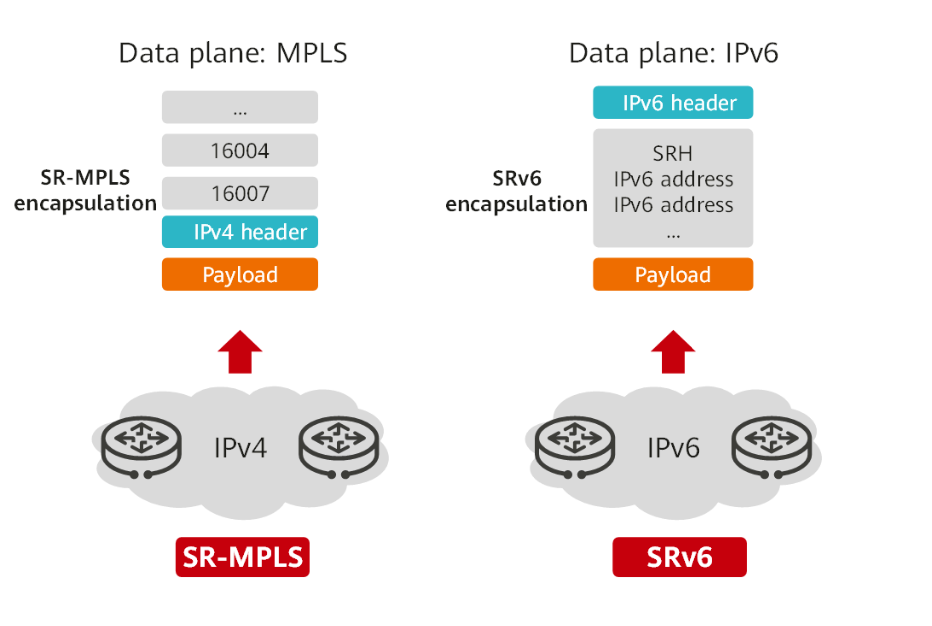
With the concept of “programmability” firmly established, SRv6 enables a network to encode individual instructions for packets directly into their headers.
In “SR-MPLS” (Segment Routing MPLS), these instructions are carried in ; in SRv6, these instructions are carried natively in the IPv6 header with the addition of an extension called the SRH, or Segment Routing Header.
Features and Benefits of SRv6.
- Simplicity: SRv6 eliminates the need for complex signaling protocols, thereby reducing operational complexity and associated costs. With the use of IPv6, a native header extension, and an IGP (OSPF or IS-IS), the system becomes much lighter compared to other technologies, such as the protocol stack required for MPLS to operate. Its simplicity is also a major advantage in migration scenarios and for interoperability with equipment that does not support SRv6, since SRv6 is simply IPv6 with extensions.
- Flexibility: With SRv6, packets are routed based on IPv6 segments, enabling more granular routing that is adaptable to the needs of modern applications. Designed from the outset with adaptability and programmability in mind, it not only solves the current problems of emerging networks but also opens up new possibilities for interconnecting networks more simply and effectively.
- Scalability and Efficiency: SRv6 is designed to support large-scale networks and offers advanced routing mechanisms that improve performance and network resource utilization. Tactical and reactive traffic engineering becomes simpler without the need for a “full-mesh” of other protocols for signaling information, as is the case with MPLS.
Comparison with Legacy Technologies
When comparing SRv6 to legacy technologies such as MPLS, it is clear that SRv6 offers a more streamlined, flexible, and adaptable approach to the current needs of communication networks. While MPLS remains a viable solution for many scenarios, SRv6 is emerging as the preferred choice for service providers seeking innovation and efficiency in their network infrastructures, especially as the demands of “the future” become increasingly evident in these networks.
Conclusion
Segment Routing over IPv6 (SRv6) represents a significant advancement in the field of communication networks, offering a simpler, more flexible, and more scalable approach compared to legacy technologies such as MPLS. With the growing demand for digital services and more efficient network infrastructures, SRv6 is likely to continue gaining prominence and become an integral part of future network architectures. The growing demand and requirements that 5G and the IoT place on networks make it clear that SRv6 is the future, as it addresses and resolves current and future challenges in the field of communication networks.
If you’d like to discuss SRv6 project deployments, please don’t hesitate to contact us. We have a team ready to deploy SRv6, migrate from MPLS to SRv6, and help your company through this process of transforming its transport networks.