
Hey guys!!
This is Luís Dias, a consultant at Made4it, and today we’re going to talk a little bit about CDNs—more specifically, Google Global Cache (GGC)—a really cool and interesting topic that’s been part of our lives for a long time and makes our work on network scalability much easier.
It’s a very interesting topic and requires a little attention, so grab a strong coffee and come with me.
First what is CDN?
A CDN short for Content delivery network is a geographically distributed group of servers that accelerates the delivery of web content, bringing it closer to where end users are. This device uses caching, a process that temporarily stores copies of files so that you can access Internet content from a device more quickly through a server near you. CDNs cache all kinds of content such as web pages, images and videos. This allows you to watch a movie, download software, post to social media or shop without having to wait for the content to load.
GGC – Google Global Cache
GGC, or Google Global Cache, refers to Google’s servers located at ISPs in Brazil and around the world. GGCs are servers installed within the networks of ISPs and telecom providers to improve users’ experience with Google content, providing faster speeds, lower latency, and a better user experience with Google services.
Google’s CDN not only improves the user experience on its platform but is also used to reduce congestion and cut down on Transit, PTT, and Peering traffic to Google. This, in turn, reduces costs for ISPs and carriers.
It’s nothing more than a very good arrangement—both for Google, whose users are happy with the performance, and for the ISP, which benefits greatly by saving on the amount of bandwidth or traffic.
How GGC works:
When a user requests content – for example, a video, web page, or image, the Google System determines whether the content can be served from the GGC Node.
If the GGC Node has the requested content in its Cache Server, it will serve the content directly to the end user, improving the navigation speed/latency for the user and optimizing the ISP’s bandwidth resources.
If content is not stored in the Cache Server, the GGC Node will retrieve that content from Google’s servers and store it for future requests.
How the GGC request is made:
In order to be able to make the GGC request, we first need to know how much traffic we have for content from Google.
Because like every CDN, we have a minimum bandwidth requirement for content related to Google, such as Youtube, etc.
Today the minimum bandwidth is traffic greater than 3Gbps – 95th percentile for at least 3 months.
95 Percentile*– is a mathematical calculation used to evaluate regular and sustained use of network communication links.
But you must be wondering “Luís, how will I know how much traffic I have for Google, to request the GGC?”
For this procedure, we can use a NetFlow tool; in this case, I’ll be using Made4Flow, the best and most practical NetFlow tool on the market.
Let’s understand how this magic works:
Upon entering, we are faced with the Dashboard of the tool, where we can specify the type of traffic we want to generate the consumption report, or we can choose the dashboard we want, in this case to see traffic to Google, Netflix, Facebook, Akamai.

When we enter the Google Dashboard tab, we will be able to see how much total traffic we have for Google and check if we will be able to request the CDN, since they ask for a minimum percentile traffic.

After analyzing it, we were able to proceed with the GGC request
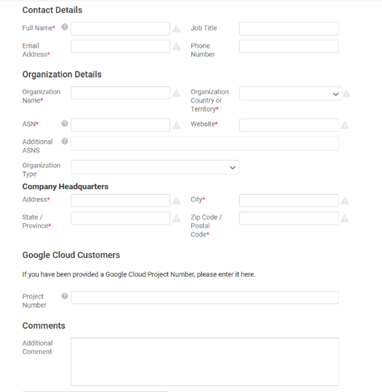
To request the GGC (Google Global Cache) it is necessary to enter the website: https://isp.google.com/partner_request/?data.request_type=Peering
And we fill in the form where we are going to put our data such as ASN, name, address, etc.
After the request is approved, we will receive an email, informing whether we were approved or not.
If approved, Google will report to us the step by step that we must follow and will give us an estimate of how long it will take for the server to arrive at the address we provide in the form.
I hope you enjoyed and understood the content! If you have any questions, please contact our team of experts.