Learn from Luiz Puppin, a Huawei specialist, how to perform a technical analysis of the Forwarding Performance tests carried out in a laboratory environment with the Huawei NE8000 platform, validating the equipment’s ability to operate as an integrated BNG+CGN at high load.
The tests sought to verify:
- Maximum NAT44 session processing capacity
- High-rate traffic support (50 Gbps bidirectional)
- CPU behavior
- Stability and no packet loss
Purpose of Performance Tests
The aim was to prove that the Huawei solution can be sustained:
- 32,000 simultaneous PPPoE subscribers
- 32 million NAT44 sessions
- 50 Gbps of unidirectional traffic
- 50 Gbps bidirectional (25G up + 25G down)
- No packet loss
- With CPU operating within acceptable standards
These features are essential for ISPs and operators with a high concentration of subscribers behind CGNs.
Architecture used

The topology used connects:
- 1 NE8000 acting as CGN/BNG
- Traffic generators simulating thousands of CPEs via PPPoE
- Simulated transport network
- Server simulating Internet/public prefixes
vsm on-board-mode disable
license
 active nat session-table size 32 slot 4
 active nat bandwidth-enhance 90 slot 4
#
nat session aging-time udp 40000
nat session aging-time icmp 40000
#
user-group nat1
ip pool ipv4-1 bas local
 gateway 30.0.0.1 255.255.0.0
 section 0 30.0.0.2 30.0.255.255
#
ipv6 prefix nd-1 delegation
 prefix 2025::/48
#
ipv6 pool nd-1 bas delegation
 prefix nd-1
#
service-location 1
 location slot 4
#
service-instance-group group1
 service-location 1
#
nat instance nat1 id 1
 port-range 1024
 nat ip access-user limit 32
 service-instance-group group1
 nat address-group group1 group-id 1
  section 0 211.0.0.1 211.0.0.250
  section 1 211.0.1.1 211.0.1.250
  section 2 211.0.2.1 211.0.2.250
  section 3 211.0.3.1 211.0.3.250
 nat outbound any address-group group1
 nat filter mode full-cone
#
acl number 6001
 rule 5 permit ip source user-group nat1
#
traffic classifier nat1
 if-match acl 6001
#
traffic behavior nat1
 nat bind instance nat1
#
traffic policy nat
 classifier nat1 behavior nat1
#
traffic-policy nat inbound
#
radius-server group radius
 radius-server shared-key-cipher huawei
 radius-server authentication 172.16.75.51 1812 weight 0
 radius-server accounting 172.16.75.51 1813 weight 0
 undo radius-server user-name domain-included
#
aaa
 authentication-scheme radius
 accounting-scheme radius
 #
 domain nat1
  authentication-scheme radius
  accounting-scheme radius
  radius-server group radius
  prefix-assign-mode unshared
  ip-pool ipv4-1
  ipv6-pool nd-1
  user-group nat1 bind nat instance nat1
#
interface 100GE0/5/0.1
 ipv6 enable
 ipv6 address auto link-local
 statistic enable
 user-vlan 1 4000 qinq 1000
 bas
 #
  access-type layer2-subscriber default-domain pre-authentication nat1 authentication nat1
  authentication-method ppp web
  authentication-method-ipv6 ppp web
 #
#
interface 100GE0/5/1
 ipv6 enable
 ip address 100.0.0.1 255.255.255.0
 ipv6 address 100::1/64
Methodology
- Authenticate 32,000 PPPoE subscribers in the DUT.
- Create UDP traffic with 512-byte frames, saturating the advertised capacity of the CGN card.
- Measure:
- Sustained real traffic rate
- Packet loss
- Number of NAT sessions created
- CPU utilization
- Repeat the procedure in two scenarios:
- 50 Gbps unidirectional
- 50 Gbps bidirectional (25G/25G)
5. Evidence and Results
Below are the verifications taken directly from the test file.
5.1. Subscribers successfully authenticated
The report confirms the simultaneous authentication of thousands of PPPoE subscribers:
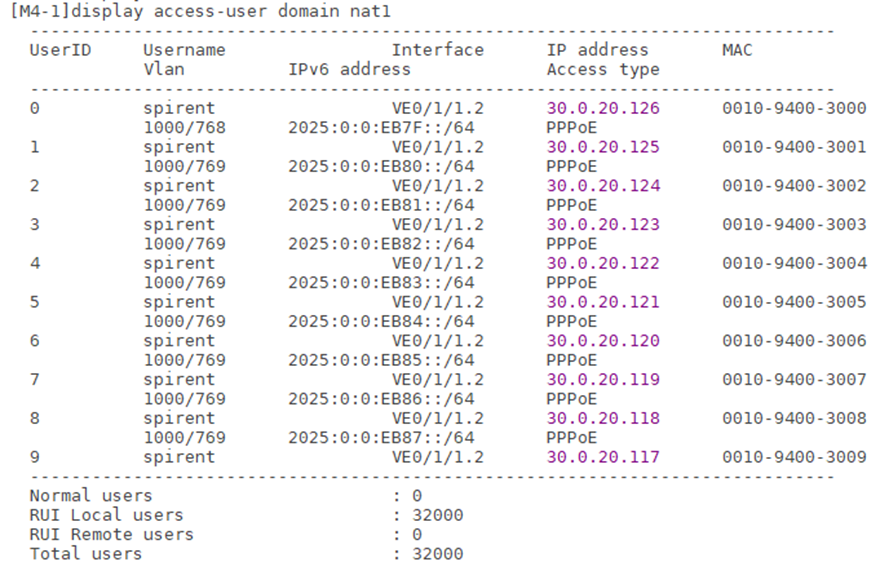
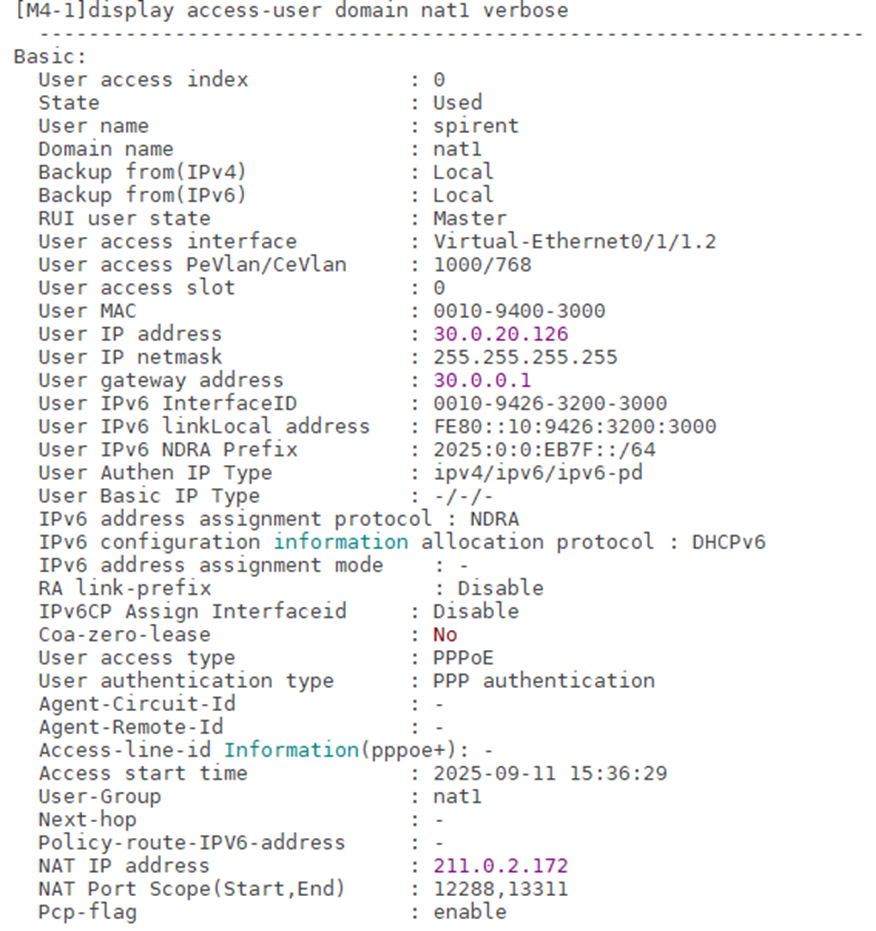
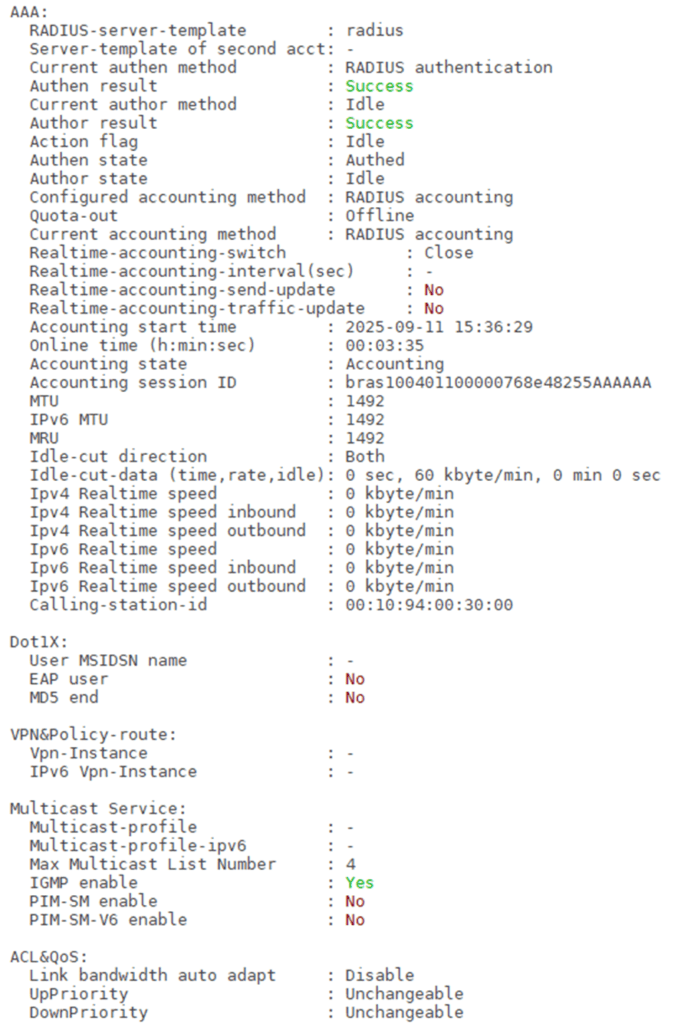
The total validated was:
- 32,000 subscribers → confirmed in the report.
5.2. Creation of 32 million NAT sessions
The DUT has reached the scalability limit set by the manufacturer:

In other words, the equipment was able to withstand 32 million simultaneous streams without any noticeable degradation.
5.3. Sustained Traffic at 50 Gbps – No Packet Loss
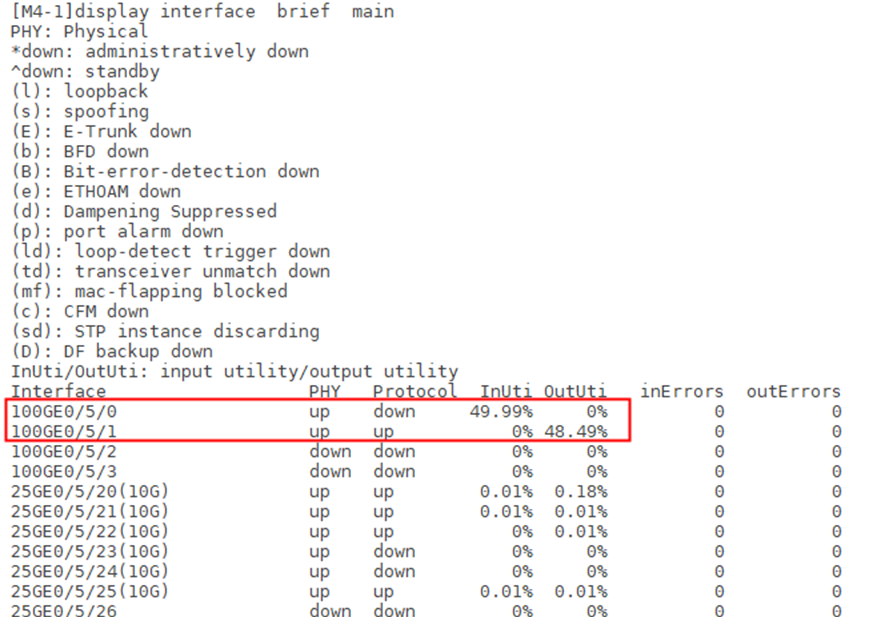

In other words:
- Continuous 50 Gbps upstream traffic
- Zero proven loss in equipment and generator
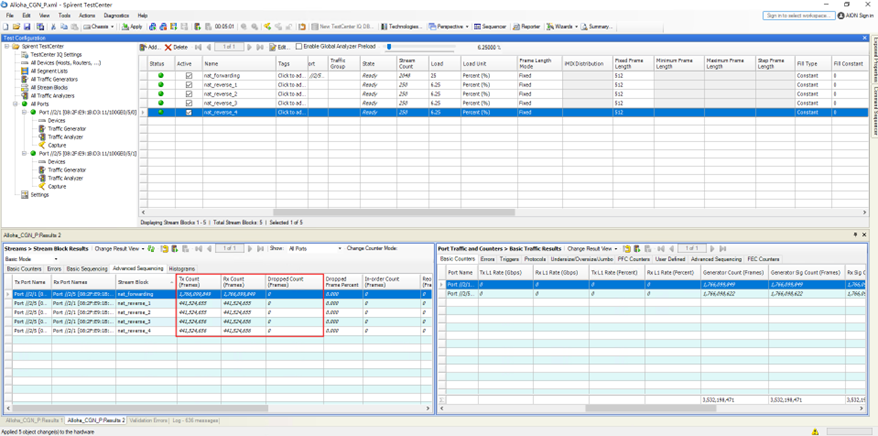
5.4. Bidirectional traffic 50 Gbps (25G + 25G)
The laboratory validated simultaneous upstream and downstream operation:

Again, with zero packet loss:
5.5. CPU stability

The CPU remains at stable levels, without reaching critical limits.
5.6. Completion of Performance Tests
Based on the evidence, it is possible to conclude that:
- The Huawei NE8000 solution can handle extremely high traffic loads.
- 32 million NAT44 sessions were sustained without fail.
- The equipment maintained 50 Gbps of continuous traffic, both unidirectional and bidirectional.
- In all scenarios, there was zero packet loss.
- CPU usage remained stable and within acceptable levels.
Therefore, the platform demonstrates real capacity to operate CGN/BNG in large-scale environments, with a high volume of traffic and a high density of subscribers. This article was developed in collaboration with Huawei Brazil’s team of ISP IP Product Managers, with special thanks to Thiago Sério and Natan Fernandes.
Need help setting up your Huawei devices? We can help you!
I want to learn more